Episode Transcript
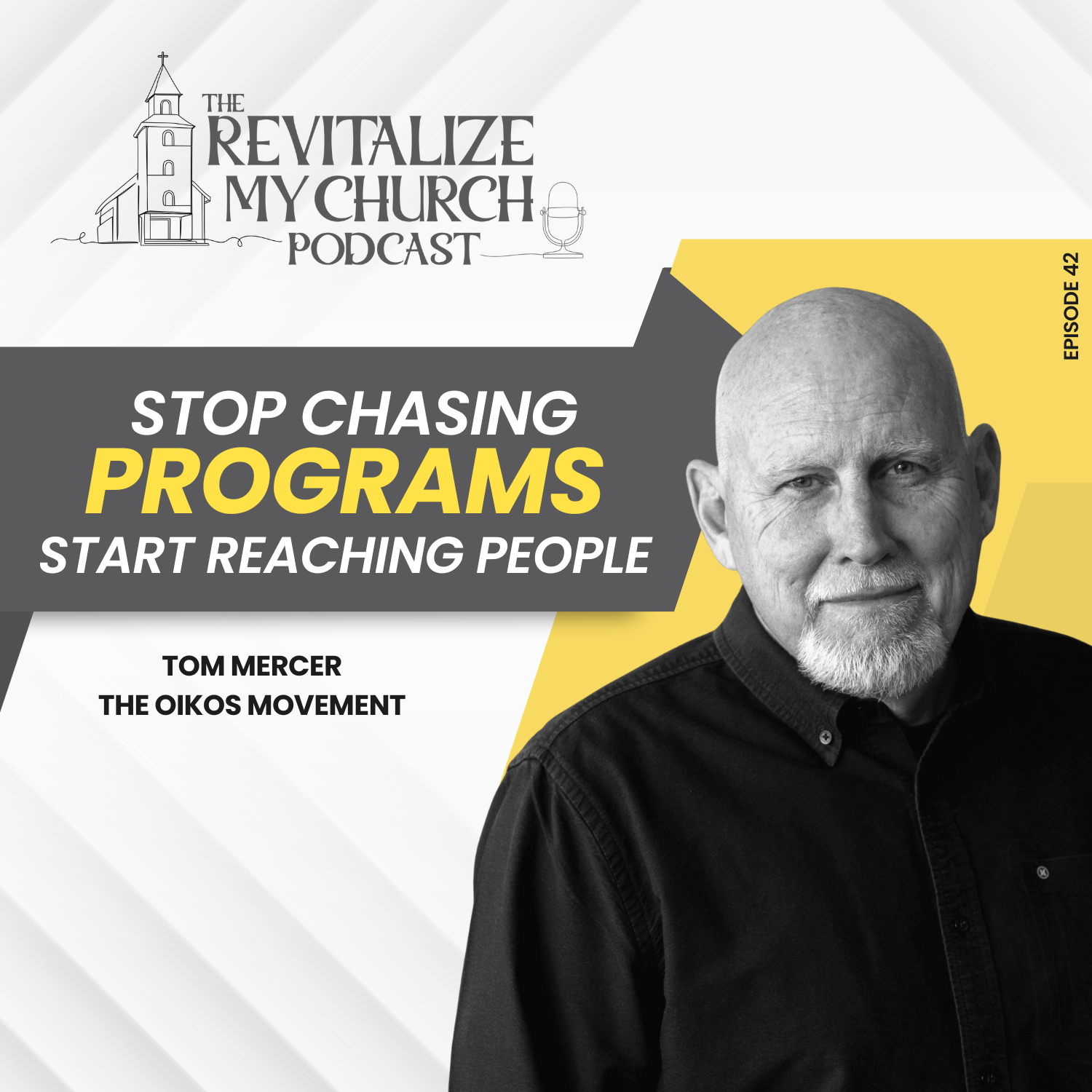
Okay, here we go. Counting down in three, two. Well, Tom Mercer, thank you so much for joining me today on the Revitalize My Church podcast. How are you doing? I'm doing great, Bart.
Thank you for inviting me. It's a pleasure to get to know you a little bit too. Yeah, I'm excited to hang out with you. We're recording this in early 2026. Earlier this year, I released a podcast episode recommending some books to our audience, to our listeners.
And you wrote a book that made that list. And, you know, you should feel good. I don't recommend. I mean, I have you and Craig Groeschel on the same list. How can you go wrong there?
Both names roll off the tongue easily. Yeah, exactly, exactly. Tom Mercer. Tom Mercer. Before we get into the conversation about the book and the principles that I'm really excited to get into, share a little bit about your background, your ministry journey, and how you ended up doing what you're doing today.
Yeah, well, I grew up in a Christian home, a ministry family, and went to Biola College, now Biola University. Attended Talbot Seminary, went through a little rebellion after that and kind of dismissed the call that God had placed on my life to be in the ministry for a year or so. But then any. Anyway, found myself in a youth ministry where actually learned the Oikos principle at a seminar I attended. And then after seven and a half years as a youth pastor, we moved up to the High Desert.
Ended up staying at High desert church for 38 years. And now after stepping aside in 22, my wife and I lead a group called the Oikos Movement, which obviously is a big part, a big piece of our ministry has been for a long time, but now we lead a nonprofit that tries to equip every believer in every nation to reach their holocaust with the gospel. So that's what we're about. Awesome. You and I had a geography.
You gave me a geography lesson before we started recording. Because I'm like, okay, High Desert Church was the name of the church that you pastored for 40ish years? I think 38. 38, okay. Pretty close to 40.
He pulled the chute just short of four decades. Right? Gave up a little too early. High Desert for all of our non California, Arizona, Nevada friends who wouldn't have any idea what the High Desert is. Where is the High Desert?
Well, the High Desert is in Southern California. And I describe it for those outside of the region as about halfway between San Diego in Las Vegas, Nevada, on Interstate 15. Okay, so that's. That's where it is elevation. I googled it and I looked at it from Google Maps and it looks like a desert.
It looked, you know, I looked 4,000, 4,000 foot elevation. Okay, so it is a high desert. We have a little bit of season and. But it's kind of tundra. You get some snow in the winter.
Oh, yeah, yeah. Okay. But we get, it's pretty cool in the winter and yeah, it's warm like the low desert in the summer. But okay, yeah. So, all right, so you're at the same church for 38 years and the church that you started at did not look like the start that the church where you finished.
Give us a little bit of an overview of, you know, where, where the church was when you got there and sort of what the church looks like today. Well, when we arrived, it was a church of about 120 attenders. Wonderful group of people, and we do not necessarily love the desert, so we didn't think we'd be here long. And yet the Lord just worked in some pretty amazing ways. And 38 years later, we had four campuses and thousands of people and it was kind of a monster, but it was, it was an amazing opportunity for us to stay put in one location for a long time, work with some amazing co workers.
Our team was incredibly efficient group of godly men and women, and I was very fortunate and blessed to work with them. Now, one of the things that we talk about on this podcast often, most of the pastors that are listening to this or watching this on our YouTube channel are pastoring what we would consider to be small or normal sized churches. The that you walked into 120ish people, I consider that a normal sized church. Although we're working with churches that, you know, are in the teens and twenties, some very, very small churches. Our goal is not to help small churches get big.
And we say that all the time. Our goal is to help all churches get healthy. I'm not one of those people that prescribes to the, you know, every healthy church is a growing church. But I do think if you want to have a healthy or if you want to have a growing church, it needs to start with being healthy church. If you're growing an unhealthy church, all you're going to end up with is a bigger unhealthy church.
So as you saw the high desert church grow exponentially over the course of the decades that you were there. What were some of the, what were some of the key seasons? If you look back on it, that kind of sparked some of the Growth and maybe what were some of the big surprises for you along the way? Yeah, well, that's very good question. We, the surprise was how long we stayed.
You know, I give, I grew up in a pastor's family that moved about every four or five years, okay. To a new location, new ministry. And so the opportunity to stay put for as long as we did was, was wonderful. Had the ministry not really been healthy, it would not have been possible. But health is, as you say, Bart, health is key.
I, I find the healthiest churches are able to unite around a common mission and get every, every local church is so diverse and ours is no different, was no different, continues to be no different. But if you're able to help people aspire to something bigger than what they disagree on, you can keep something really good going for a long time and it remains healthy indefinitely if the mission doesn't change. Pastors become more plug and play. And so I, I, I think that's been the key to, you know, our health, I guess, is just to rally the church family around the Great Commission, which just happened to be the only thing Jesus asked of us between his advents. So as we, as we were able to keep a congregation focused on that and recognize that every member of the congregation, every attender who knows Christ and, and claims to be a Jesus follower would just rally around the mission of the church.
I have a lot that sounds kind of lofty and kind of spiritual, but actually it works pretty well. Well, it's interesting. I want to kind of double click on that for a moment because I think that is probably one of the biggest challenges that church leaders have, especially as their churches, if you're, if you're fortunate enough, blessed enough to be in a church that is growing, whether you grow from 20 to 40 or 30 to 80 or 80 to 200 as you go through seasons and transitions. I think helping people keep their focus on the main thing is one of the biggest challenges. Because as church leaders, especially if we're creative, we tend to chase shiny things.
We tend to play like, I think it's Dave Ramsey that says, you know, he says, don't be a bass. Don't chase all the shiny things that come in front of you, right? Because they can be really distracting. One of our principles at assist church expansion, that we preach and teach and coach as we're coaching churches through revitalization is a principle. It's basically unity.
How we keep the church unified on a primary purpose, a primary mission. You know, what, what advice would you have or what experiences would you be able to share with how you were able to keep the Great Commission, the main thing in your church, when people naturally begin to start asking questions, well, what do you have for me, people? That this is just our culture, right? It's church culture. I need more of this.
We need more stuff in the women's ministry. We need more stuff for the youth minist ministry. We need, we need this kind of ministry and that kind of ministry. How, how do you, as the leader, keep people focused on that main thing? Well, yeah, that's good.
Another good question. When, when people would tell me they really need a particular ministry, the question was why? If that is something Jesus asked of us, then of course we're obligated to pursue it. But there are so many things that are so distracting. I, you know, on record of saying, having said many times, it's not that local churches don't do good things, but we do so many good things, then the only great thing Jesus asked of us doesn't have any room to flourish.
And so, yeah, that, that, that really is a key, is to elevate the mission first and often. My friend Dave Browning, I don't know if you knew Dave, he's with the Lord now, but he wrote a lot about this idea of the two functions of the church or different processes that we elevate for a church family. One is outreach and the other is nurture. And he said, without intentionality, nurture always wins. And I grew up in a Christian environment, wonderful, you know, heritage in the faith, and attended wonderful churches with wonderful church leaders.
But I was taught that if you just pursue nurture, at some point, the outreach will happen automatically, that we will be so full of Jesus, he will just spill over into the lives of the non believers around us or the marginal believers around us. And I looked around and just concluded that never happens.
It never, ever, ever happens. And that's why we have taken the outreach piece and we have elevated that first and foremost. It doesn't compromise what we do on the discipleship side. It simply gives a context for discipleship. And, you know, the listeners might have a little smile on their face when I say this, but most churches, when somebody comes to Christ, whether through a relationship outside of the church building or whether in a church service, I asked pastors, well, what's the first thing you tell the new believer they need to do?
And the answer always is, well, you need to get in a Bible study. You need to get in a growth group. And I know this might sound somewhat heretical to some of your Listeners, maybe all of them. But my advice would be to never, ever, ever, ever do that. The first thing you do with a new believer is to paint the target.
And the target is the oikos, those 8:15 people. God is supernaturally and strategically brought into your life. We use the, the illustration of the theater. These people are sitting in the front row seats. They get the best seats in the house to see how you live and to listen to what you say.
So when we had people come to faith, right from the beginning, we said, okay, we're going to help you understand what your mission is. It's those 8 to 15 people. Because 95% of kingdom growth occurs in the front row. And that's obviously not the front row of the church building. Right?
That's the front row of our lives. That's within that Oikos context. Okay. Once we've painted the target, this is what, as a Jesus follower you're going after. You're going to become the best iteration of Jesus for these people to see, for these people to hear.
And I've, I've always maintained, and I don't think anyone in, in your audience or any Christian audience would disagree. Jesus does a really good job of selling himself, but people around us who don't know Jesus don't see him and can't hear him.
And if we could become a better representation of who Jesus is, then Jesus will take over. He'll just, he'll sell himself. He's. He's pretty good. So our job, in my opinion, is to elevate the mission.
And the mission is the Great Commission. Jesus scaled the Great Commission to the Oikos Principle. He's given all of us 8, 15 people. Every human being on planet Earth has an oikasa that scale. And now God calls us to focus on those 8:15.
And as we do, and as we go to church on the weekend and we go to our small groups and our Bible studies, we're learning to become better representatives of Jesus for those eight to 15 people, because that's where the kingdom is built. That's what the New Testament teaches and that's what the data reveals. So that's why I'm all in with this idea. You're all in. Dan Ryland.
I don't know if you know, Dan had him on the, on the show last year. And one of the things that I remember him saying was he's never seen a church that naturally gravitates towards evangelism. Most churches naturally gravitate towards what you're referring to. As nurture. It's an inward focus, not an outward focus.
And it's not to say that discipleship and nurture is a critical piece of church life. In fact, I shared with you before we started recording that I recognize as a leader and as a pastor, one of my deficiencies is that I'm not a strong nurturer. And I realized that because I'm so hardwired to evangelize my community, to reach lost people, I oftentimes, as a leader, I'll be honest with you, I've caught myself caring for the people outside of my church more than I cared for the people inside my church. And the Lord had to convict me on that multiple times because I had to find the balance there. There has to be a balance.
But you're right that, you know, the Great Commission does begin with making new disciples so that we can actually disciple those disciples. So it's the cart before the horse here. Okay, you've already begun to kind of peel away some of the layers here of this 8 to 15 concept. And I'll just be perfectly honest with you. I read a lot of books last year.
Yours had probably one of the weirdest titles. Okay, I said it was one of the best books I read last year. It was one of the most helpful as far as ministry strategies is concerned. But it's an odd title. Okay, you pick up this book, it's called 8 to 15.
What does it actually mean? Let's break that down a little bit, and then we're going to get super practical for our audience in terms of how they implement an Oikos principle with this 8 to 15 in their church. So let's talk a little bit about it. What's the inspiration? Where did it come from?
What does actually mean? Well, the word oas means yogurt in Greek. Totally kidding. It has not nothing to do with that. It means house or household.
It, you know, depending on the context. In the Greek New Testament, it can describe the physical dwelling where you live, or it can describe the. The relational world where you live. And so when, for example, the demonized man in the Decapolis was delivered from his demons, he begged Jesus to go with Jesus and the disciples back to Galilee. And the text is very clear.
Jesus said, no, it. It's in fact, it's rather harsh. Jesus would not let him. He said, but what I do want you to do is go home to your own people. That's the new international version translation of the word Oikos.
Go home to your own people and tell them What I've done for you and how I've shown you mercy. The next time. Now, this whole region had didn't want anything to do with Jesus when he visited and healed that man. Next time Jesus and the disciples show up, they're coming out of the woodwork asking Jesus for his help. And the difference between those two visits is almost bizarre.
But the difference is one man who took Jesus at his word and decided to go back to his Oikos and begin to be intentional about the gospel. So those 8, 15 people, I've said it already, got it supernaturally and strategically, put them in the front row seats of your life. You ask once you've understood what an Oikos is. It's your co workers, your neighbors, your close friends, your co workers, your classmates. Once you've identified who is in your Oikos and on average, at any point in time in our lives, Bart, it's anywhere from eight to 15 people.
Once you've identified the front row, you're on your way. In fact, I probably asked hundreds of audiences on five different continents over the last 20 years. I believe every iteration of evangelical Christianity. In some meetings, some denominational setting, some local church, I've asked the question, how many of you would say, once I've explained what an Oikos is, how many of you would say that the primary reason you gave your heart to Christ was because of the influence of someone in your Oikos. Hundreds of thousands of people, different kinds of churches, different languages, different cultures, different continents, different resource levels, different ethnicities.
Everything is so different in the Christian community. But I've never gotten a different answer to that question, ever. Virtually the whole room raises its hand. When I recognized that God scaled the Great Commission to the front row of every believer once that switch flipped for me, it completely revolutionized my life and my ministry. I even told the new attenders at High Desert Church, at our members class, I said, listen, my name's Tom.
It's a pleasure to be your lead pastor. I just want you to know I got one goal for your being a part of this church, and that is to be the best representation of Jesus for your front row that you can possibly be. My job is to help you reach year eight to 15. And that's all we did at HTC. Everything that we started in terms of, for lack of a better word, programs was directly related to the front row of our attenders.
And we did experience good growth. I'm not sure we should be so consumed with measuring growth. I've never been interested really, in measuring growth, it's above my pay grade to cause growth. So it's kind of silly for me to take credit for it by measuring it. But I do think we need to be faithful to that one thing Jesus asked of us in that one context where his Kingdom is built 95% of the time.
That's focus. And helping a local church congregation focus on that idea. Can it? It always bears fruit. I'm not sure, again, that we should make such a big deal about the growth, but I think we need to be faithful to the idea.
I don't know if you're familiar with the terms lead measures and lag measures. In terms of things that we measure, lead measures are the things that we can control, and lag measures are things that we can't. And I often tell pastors that, you know, your numeric growth on a Sunday or the number of baptisms that you have in a year or the number of people who. Who give their lives to Jesus is a lag measure. Those are not things that you can actually control and manufacture.
You can't. You can, sure, you can set a target and say, we'd like to see our weekend attendance grow from here to here, or we'd like to have a target of this many baptisms during the year. But it's the lead measures or the things that you do that you invest in that ultimately result in those things. And, you know, from an evangelistic perspective, which is really the point of what we're talking about here, is if you're not engaging in relational connection with people who are far from God, with an intentional plan of trying to help navigate. Help them navigate their atonement towards Jesus, then I don't know why you would expect to see growth in any way, certainly not kingdom growth.
You might. You know, you can be a good preacher and you can see people leave their churches and come to your church to hear you preach. If you happen to be a really gifted communicator or have the best worship band in town, or maybe have a killer marriage ministry ministry or children's ministry. But if you want to see actual conversion growth, it's going to have to start with the fact that you have to meet new people or you have to invest in relationships with people that God's already brought into your Oikos and do so intentionally, you're kind of dancing on some territory that we talk about often in our show and in our ministry, and that's that most of the time, we, as American evangelicals, we sort of believe that people who don't follow Jesus or who have an aversion to the gospel or to scripture, that their primary issues are theological. We really believe that they're really mostly sociological.
They're not theological. People who tend to resist the gospel or resist the idea of God, or resist the authority of the Bible are typically doing so because most of their Oikos does the same thing. And so if and when we can actually start changing people's sociological circle, their sociological engagement, surround them with and by more people who, who do believe in Jesus, follow Jesus, hold high value of scripture, then all of a sudden their eyes seem to be open to more possibility and they tend to be less, less defensive about trying to hold to a theological position that they don't even know. They probably can't even explain. Right.
So love, love where you're going here. Let's get really practical in the context of, you know, a high desert church or any other church that you would be coaching to try to apply, apply this oikos principle, this 8 to 15 principle. How would you implement this into the context of a local church? Well, primarily you need to teach the principle and you need to remind the congregation often of its import. We had a strategy, a five step strategy that we tried to keep people focused on and that was to, number one, make a list.
Who are the eight to 15 people in your front row seats who really have the best seats to watch you live and to hear what you say? Most believers have never taken the time to write down what the target is here. And I'm talking names, I want to take names. And I, I just, and this isn't something you broadcast, not something necessarily share with anybody else. It just becomes your personal understanding that these are, to use the words of Jesus.
These are your own people the God has called you to reach. If you ask the average believer if they would like to have an impact for the kingdom of God, most of us would say yes, but it's only a dream until you write it down. Then it becomes a goal. You're in Dallas. Emmett Smith said that at his hall of Fame induction ceremony.
It's only a dream until you write it down, then it becomes a goal. You want to dream about having an impact. Dream your whole life away, bro. You, you want to make it a goal, Write those names down, then begin praying every day. Make a list, begin praying every day.
Then be intentional about investing in those relationships. And then that fourth piece is the invitation. The invitation into environments where faith conversations happen. That could be church, that could be your home for dinner, that could be Starbucks. Let's get together.
But then the invitation. You know, as a youth pastor, early on in my youth ministry, we would knock ourselves out putting these great youth programs together. We say, invite your friends again. Nobody ever did. Nobody invited them.
You put together great Christmas programs and tell your church family, invite your non believing friends and neighbors to come, but nobody ever does. Bart. And the reason they don't extend the invitation is because they haven't made the investment. And because they haven't made the. The reason they haven't made the investment is because they haven't been praying.
And the reason they have been praying is they didn't write it down. And so we're pretty focused about this strategy to identify and to remain focused on what the mission is, what the target is. And then on the other side of that, you introduce the strategy and remind them often about it. But then you have to minimize the distractions. We had a season where we were a little bit frustrated with everything that was going on at the church.
And so I finally asked the team, I said, why don't we just ask these people what it is they would give us in terms of time? Every week we had the conversations in small groups. We did some exit exit polling, we did some focus groups, we took a literal written survey, and we said, okay, you've bought into the church you like, coming to the church you attend, you know, a few times, at least a month. How much time every week could you give us?
And the answer they came up with, and this is the high desert, every community may be a little bit different. I'm not saying it's true across the board, but what they came up with was five hours. Five hours a week. Essentially. They said, tom, we love you, we love the church, but bro, we got no more time.
We're working two jobs, we're raising 3.2 children, we're running around to sports leagues and dancer recitals and, and, you know, school. And we, we're trying to keep our marriage alive. We're trying to have a date night where we just, we're trying to movie night with the kids. We can't give you more than five hours a week. So then I said to the team, okay, we get five hours a week, you guys.
That's all we get. So let's create a structure or a system that takes five hours a week. And we started with, okay, what's your, what's our priority event? Well, a worship service, because that's when you get most of the people. So, all right, we got to plan A meaningful worship service.
But we just. We just lost 90 minutes of our five hours. And then we wanted to go to a small group because every good presentation deserves a good conversation. So, all right, we're going to bring him to a small group. So we got a couple of more hours.
You gotta. We're down to an hour and a half left of the five hours. And then we said, well, we're kind of stuck with spiritual gifts because that's in the Bible. So. So we have to create opportunities for people to express their gifts or spiritual gifts, either here in our church or in the community.
Well, that was going to knock off another couple hours. So we're tapped out, right? So really, all we were focused on doing was to provide a meaningful weekend service, meaningful small groups and opportunities to express your spiritual gifts at the church, at one of the campuses, or in the community. We did virtually nothing else, at least not ongoing. We.
We would perhaps have seminars and. And we would have some, you know, terminal events. That has nothing to do with lifespan simply. Well, not a person's lifespan had everything to do with the event or the classes. Lifespan would just do things that just took a week or two at a time.
But we didn't offer these things on an ongoing basis because I found that, man, the more good. The more things you offer the church family, the less focused they become on that one thing that Jesus asks us to do. So anyway, those two pieces just introducing a new strategy and then minimizing the distractions. And these are good distractions. I got no problem with all of the programs and all the different events and things that could take place.
But again, if they're kind of drowning out the. The great thing Jesus gave us to do, then it becomes a problem. You reiterate the principle that I've heard so many leaders say over the years, and that is saying yes to one thing is saying no to something else. So the more you say yes to, the more you have to realize that it prevents you from being able to say yes to other things. And I think.
I mean, when you said five hours right out of the gate, I'm like, man, if you're getting five hours of people, you're doing really well. Because that surprised me. I was expecting you to say, we'll give you two. Right? But that's.
But you got to maximize those five hours. They have to be good five hours. I mean, we took that so seriously. All of these teams that, you know, we had a pretty large ministry, and we had a lot of people involved in leadership and our Our job was not to come up with new things to do. Our job is to do the things, those three things better and for more people.
But those three things we felt were the priorities that best led to preparing people for their mission to their 8:15.
So, yeah, it's, it's, you know, most local churches are frankly obese. Over the years they just added things, you know, I'm, I'm 71 now. I, I was a buck 80. I was about 180 pounds until I turned 45. And then I learned personally that fat happens.
Nobody intentionally wakes up and says, you know, for the next season of my life, I'm just going to become more obese. But as it happens, it takes, it takes no effort. Dad, wait. But as it happens, and finally you come to the grips of the idea you're not. Back to our original conversation.
You're not healthy, man. Yeah. And most churches are not healthy because they're obese and they got so much going on. I, I've often called the Oikos principle a diet regimen for churches. And it takes a lot of work to dismantle all the non missional good things that we do.
And our BART. 76%. This is a Barnab stat from, I think it was 24. 2024. So it's fairly recent.
76% of evangelical church attending Christians could not even articulate what the great commission is.24 of the people we preach to every day even know what it is. You know, they, they know what all the programs we offer are, but they don't know what the Great Commission is. So, and I love what Jesus said just before I deliver the Great Commission. And you know this in Matthew 28, your audience of course will remember it. What did he say?
And this is so key. All authority has been given to me on heaven and earth, which being interpreted means you guys are going to come up with a lot of ideas.
But I'm the one in charge here. Yeah, I have all authority here, so just do what you're told. And then he lays out the Great Commission and then he ends up by saying, and don't feel bad like you're on this on your own. I'm going to be with you guys, is going to be good. But then he scales it with the white cause principle and the data is unmistakable.
I mean you talk about when the new test thing about data is that it always reveals the truth. You'll notice that when it, you'll notice the Bible doesn't give data, it just gives the truth. Right. Other than The Book of Numbers. Yeah.
I mean, Jesus just said, just do this. Yeah. He didn't say, I've done research. Yeah. And this is what I've come to understand is true.
Right. I mean, Jesus said, I am the truth. Yeah. So I'm telling you guys, I, I've, I've, I've said this. Yeah.
Something I've, I've repeated many times. Some of our listeners have probably heard me preach this in their, in their churches. And that's, I think, part, part of the problem that we have is that we've labeled the Great Commission the Great Commission, because most people don't really even understand what a commission is. Commission sounds too much like suggestion, Commandment. We get love God, love others, like commandment.
We get that. That makes sense. Commission. I mean, most people don't know what a commission is. They don't understand.
So commission kind of sounds like suggestion. So it's really just a great suggestion from Jesus. No, it's not. It should have been also another great commandment. It's another great commandment.
It is a directive from the one who has all authority. Therefore, he's the CEO, he's the one in charge. He's the prime commander here, and he's giving his troops an order. And it's not a suggestion, it's a commandment. So, yeah, I'm with you on that 100%.
Tom, we are, like, quickly running out of time here, and this has been awesome. And you're one of those people that I can talk to for a really long time, and I'm excited and energized about this particular topic. I'm going to ask you a couple more parting questions here. One is, really last one for our audience is, I'm a pastor. I've got a church.
You sold me. I'm buying in. I'm going to go buy the book and I'm going to read the book. But while I'm processing this and while I'm getting the book and I'm reading the book, what would be the first step that you would suggest that, that I take to begin incorporating this idea, this concept of oikos and 8 to 15 in my church culture? Yeah, I just get decision makers.
Your leaders could be your staff team could be key volunteers. Have them read the same material and then have a conversation. People are smart. People in ministry are smarter than they think. They.
They feel like they're ill equipped to lead a growing church because they have no confidence in their own skill set or their own gift set, which is fair. The average Church is led by averagely gifted leaders. So my my challenge would be to read the 8:15 book or a follow up book for pastors I wrote after the 8:15 book. That title is Not My Church and all just start talking about it. I think God will give you some pretty good ideas on how in your specific context you can begin to develop this idea and embed it into the DNA of your church.
If you run into a roadblock, just reach out to me. Tomoycosmovement.com, go to our website oikosmovement.com and just start browsing around, start looking around and. But reach out. That's. I spend much of my time just zooming with pastors all over the world talking about this idea and I'd be more than happy to talk to them.
Awesome. Well, you answered my second question, which was if people want to learn more, they want to connect with you. How do they do that? It's Oikos movement. Every good Greek scholar ought to be able to spell that.
And if they can't, I will link to it in the show notes so people can find it. Tom, it's been a super, super pleasure having you on the show today. God bless you and whatever this season of ministry brings for you. Really just grateful for you sharing your heart today and hopefully this has been super helpful for our guests. For those of you who have made it all the way to the end of this podcast episode, congratulations.
I'm sure that you did. I want to remind you that we release podcast episodes on the 1st and the 15th of every month, which is an awkward time. It's not like a specific day of the week. So in order for you to remember, you don't have to remember. You just need to subscribe wherever you listen to your favorite podcast.
And if you subscribe, then your podcast platform will deliver each episode to your mobile device or to your phone. If you're watching on our YouTube channel, you can click the subscribe, ring the little bell and you'll get a notification every time we have a new episode. And again, this has been Tom Mercer talking about his book 8 to 15 and the concept of the Oikos movement. Glad to have you on the show, Tom. And for the rest of you, we'll see you next time.